Thickness, wear layer and core, explained board by board
An engineered white oak board is a sawn oak face bonded to a core. The thickness of that face, the build of the core and the overall thickness decide how stable the floor is, how high it sits and how much oak is left to sand later.
Pick a build on the cross-section. The dot marks our two standard builds.
- Wear layer, sawn oak
- 3 mm 1/8"
- Core and backing
- 12 mm
- Overall thickness
- 15 mm 5/8"
Three constructions
The face is always white oak. What sits under it changes how the board behaves.
2-layer engineered
Keeps overall floor height down. The usual build for herringbone and chevron blocks.
3-layer engineered
The build for wide boards and large open rooms, where dimensional stability matters most.
Solid oak
For narrower boards and projects that plan on repeated sanding over the life of the floor.
Overall thickness and wear layer
We write every build as overall thickness over wear layer, in millimeters. The wear layer is the oak you walk on. It is cut to the thickness on the order, commonly 1/16" (2 mm), 1/8" (3 mm), 5/32" (4 mm) or 1/4" (6 mm), and checked across the board before pressing.
A thicker wear layer leaves more oak above the tongue, so the floor can be sanded and refinished more times over its life. A thinner overall build keeps the floor low, which matters at doors, stairs and when the floor meets tile.
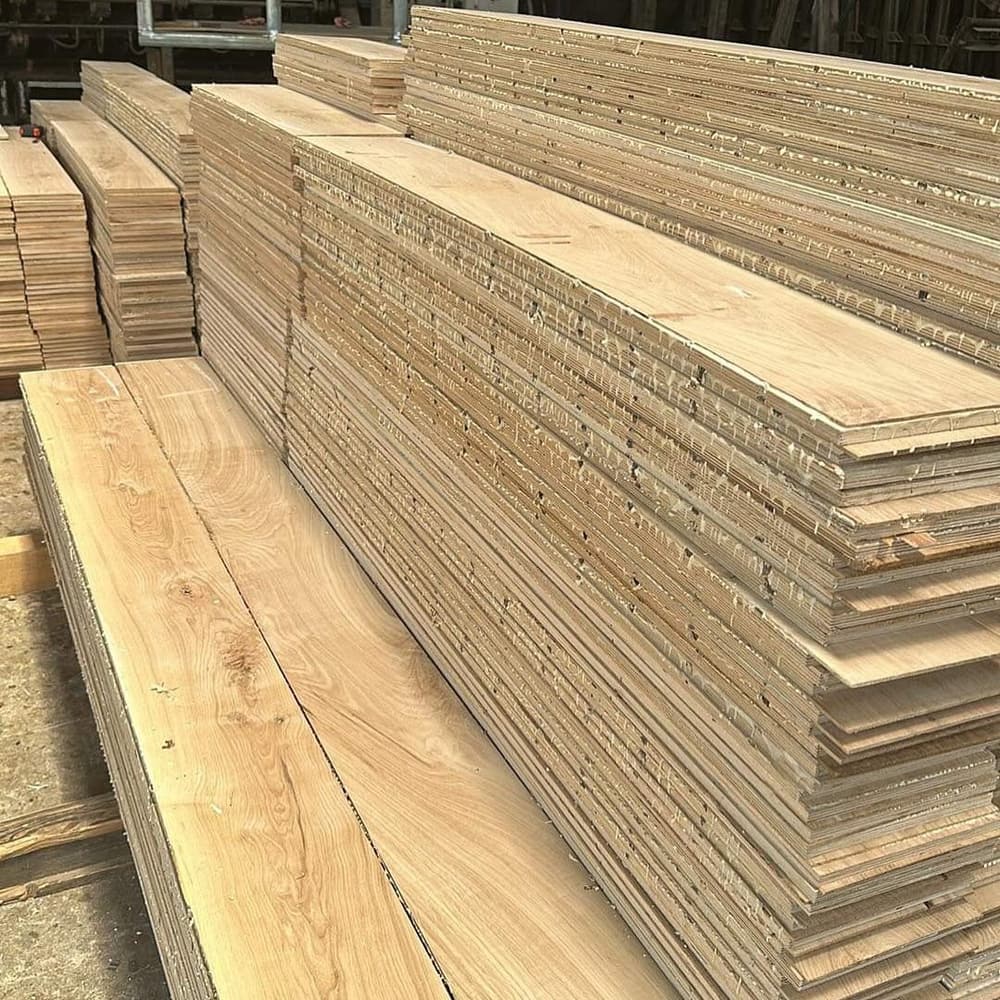
Pressed boards before sizing. The oak face and core are visible at the ends.
| Build | Overall | Wear | Status |
|---|---|---|---|
| 10/3 | 3/8" | 1/8" | Produced for past orders |
| 12/2 | 1/2" | 1/16" | Made to order, confirmed on your quotation |
| 14/3 | 9/16" | 1/8" | Produced for past orders |
| 15/3 | 5/8" | 1/8" | Standard build |
| 15/4 | 5/8" | 5/32" | Produced for past orders |
| 19/4 | 3/4" | 5/32" | Produced for past orders |
| 19/6 | 3/4" | 1/4" | Produced for past orders |
| 20/6 | 3/4" | 1/4" | Standard build |
| 21/6 | 13/16" | 1/4" | Made to order, confirmed on your quotation |
Other overall thicknesses from 3/8" (10 mm) to 13/16" (21 mm) are made to order and confirmed on your quotation.
Choosing a build
Starting points, not rules. Your installer and the subfloor have the last word.
- Wide plank, open plan3-layer, 20/6 or 19/6. The cross-layered core and backing keep wide boards balanced.
- Herringbone and chevron2-layer, 15/3 or 20/6. Blocks are milled as left and right pairs with one fixed length per order.
- Low floor height10/3, 14/3 or 15/3. Check door clearances and transitions before you choose.
- Long service lifeA 6 mm wear layer (19/6, 20/6, 21/6) or solid oak, for floors that will be sanded several times.
- StairsTreads and nosings are made to match the floor. See stairs and trims.
Construction questions
What does 20/6 mean?
It is the overall thickness over the wear layer in millimeters: a board 20 mm (3/4") thick with a 6 mm (1/4") sawn oak wear layer on top of the core. The same notation is used on our quotations.
Which build is the standard?
Our two standard builds are 15/3 (5/8" overall, 1/8" wear layer) and 20/6 (3/4" overall, 1/4" wear layer). 10/3, 14/3, 15/4, 19/4 and 19/6 have been produced for past orders. 12/2 and 21/6 are made to order.
2-layer or 3-layer for wide boards?
For wide boards and large open rooms we suggest 3-layer, because the cross-layered core and the backing balance the board. 2-layer suits herringbone, chevron and floors where overall height is limited.
Is the wear layer sawn or sliced?
Our standard builds use a sawn oak wear layer, cut to the thickness on the order and checked across the board before pressing.